Saudi Arabia: Behind the Cold War with Iran
The complex politics of the Middle East are often a mystery, but the key to understanding the region's conflicts is to recognize the strategic rivalry between two major powers. This long-standing feud between Saudi Arabia and Iran has played a central role in countless proxy wars and regional disputes, but will their ongoing power struggle ever lead to a direct, all-out war, or will it remain a cold war fought on foreign soil?
SAUDI ARABIAIRAN
Raymond Puentes & Nurila Nursalimova
9/1/20255 min read
The Middle East is one of the most complex regions in the world. Currently, there are four failing states and three ongoing wars. The region has experienced major conflicts stretching well into the twentieth century, and two countries, Saudi Arabia and Iran, have remained constant figures in these struggles as bitter rivals. Their contest has shaped the political, religious, and economic dynamics of the entire region.
The rivalry began in earnest in September 1980, when Iraq, under the rule of dictator Saddam Hussein, invaded Iran. Hussein sought to contain the newly established Islamic Republic, which he viewed as an existential ideological threat to the secular order in the Arab world. The Saudis, fearing the spread of Iran’s revolutionary ideology, provided Iraq with substantial financial support and military assistance. As Iran began to regain ground, Saudi Arabia intensified this backing. By the war’s end in 1988, nearly a million people had perished. Tehran blamed Riyadh for sustaining Iraq’s war effort, and thus began the modern Saudi–Iranian enmity that has since become a struggle for dominance across the Islamic world.
Since then, this rivalry has evolved into what many analysts term a new Cold War. Much like the global Cold War between the United States and the Soviet Union, the two powers have rarely confronted each other directly. Instead, they have waged proxy conflicts across the region, each supporting opposing factions to undermine the influence of the other. In Yemen, Saudi Arabia has backed the internationally recognised government, while Iran has armed and financed the Houthi rebels. In Syria, Iran intervened to sustain the regime of Bashar al-Assad, whereas Saudi Arabia financed and armed the opposition forces. These proxy wars have devastated regional development, worsened humanitarian crises, and entrenched instability in fragile states.
Saudi Arabia seeks to project leadership through economic modernisation and international integration. Its Vision 2030 initiative, spearheaded by Crown Prince Mohammed bin Salman, is an ambitious programme designed to diversify the economy away from oil, develop sectors such as technology and tourism, and position Saudi Arabia as a global investment hub. The programme also serves a strategic purpose: to present Saudi Arabia as the modern, progressive face of Islam in contrast to Iran’s revolutionary and anti-Western stance.
Iran, by contrast, continues to define itself through resistance to Western intervention, opposition to Israel, and solidarity with non-state movements such as Hezbollah and the Houthis. Its foreign policy remains rooted in the ideals of the 1979 Islamic Revolution, which sought to establish a political system based on Islamic governance free from Western dominance. Despite enduring years of sanctions and international isolation, Iran has strengthened strategic partnerships with Russia and China, especially following its accession to the Shanghai Cooperation Organisation and the 25-year cooperation agreement with Beijing.
The religious dimension of this rivalry is also fundamental. Saudi Arabia claims leadership of the Muslim world through its custodianship of Islam’s holiest sites, Mecca and Medina. Iran, however, asserts that it embodies the true revolutionary and spiritual leadership of Islam, as articulated by Ayatollah Khomeini and maintained by his successors. This competition between Sunni and Shia Islam has transformed local conflicts into sectarian confrontations, deepening divisions within Muslim communities from Lebanon to Pakistan.
Economically, both states rely heavily on oil and gas exports, yet they compete for influence in global energy markets. Saudi Arabia has traditionally aligned with the United States and the Western economic order, while Iran has sought to circumvent sanctions by pivoting towards Asia. Both are now members of BRICS, indicating their shared interest in reshaping the global economic system to be less Western-centric. Nonetheless, competition persists over market share, OPEC+ policy, and access to infrastructure and maritime routes.
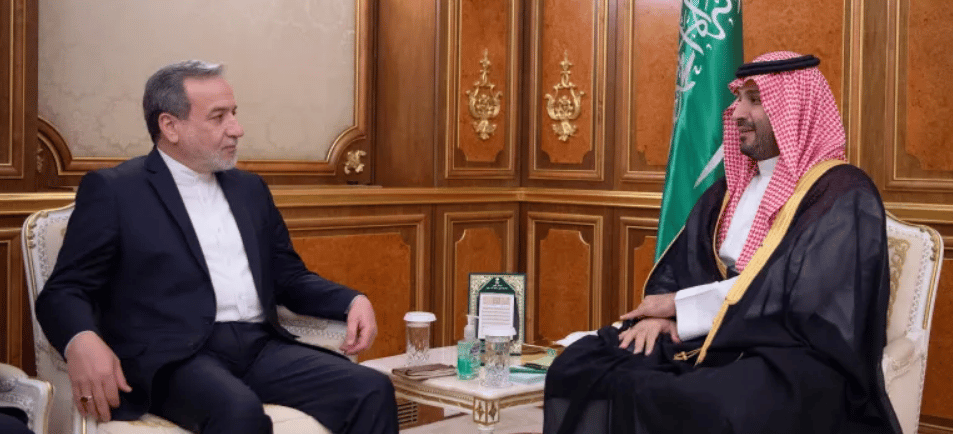
A significant turning point occurred in March 2023, when Saudi Arabia and Iran restored diplomatic relations through a Chinese-brokered agreement. Embassies were reopened, and direct communication between foreign ministers resumed. This rapprochement signalled a cautious de-escalation after years of hostility. Yet, it remains fragile. While both countries have shown restraint during regional flare-ups, particularly in the aftermath of the 2023 Gaza war, mutual suspicion persists. Each continues to view the other as an existential ideological and strategic adversary.
In Yemen, although major fighting has diminished, the country remains divided. The Houthis still control large swathes of territory and continue to target commercial and military vessels in the Red Sea. These attacks, often facilitated with Iranian technology, have disrupted international trade and demonstrated Tehran’s capacity to project power far beyond its borders. Saudi Arabia, weary of the prolonged conflict, has shifted towards diplomatic engagement but remains wary of Iran’s influence over the Houthis.
Meanwhile, in Syria, the situation has evolved dramatically. The Assad regime, long supported by Iran, has struggled to maintain control following renewed opposition advances. This has weakened Tehran’s regional axis, particularly its land corridor to Lebanon, while creating new openings for Saudi diplomacy. Iraq remains another major arena: Iran’s backing of Shia militias continues to complicate the authority of the central government and provoke Sunni resentment, while Saudi Arabia seeks to rebuild ties with Baghdad through economic investment.
Beyond these traditional theatres, both powers have expanded their reach into Africa and Central Asia. Saudi Arabia uses economic diplomacy and investment through the Public Investment Fund, while Iran leverages ideological and military ties to non-state actors. Both are also competing for influence in the Horn of Africa, where control over maritime routes and Red Sea ports has become strategically vital.
The rivalry between Saudi Arabia and Iran now unfolds in an international system no longer dominated by a single superpower. The United States remains Saudi Arabia’s key security partner, but Washington’s reduced military footprint in the Middle East has compelled Riyadh to diversify its alliances. China’s growing involvement, exemplified by its mediation in the 2023 rapprochement, marks a shift towards a multipolar order in which external powers compete for influence through diplomacy and investment rather than direct intervention.
Iran, under sustained Western sanctions, has strengthened its military cooperation with Russia, particularly through drone and missile technology transfers. The two states have aligned over Syria and Ukraine, creating an informal bloc of mutual support against Western influence. This dynamic adds a new layer of complexity to Middle Eastern politics, where the Saudi-Iranian competition is now intertwined with global rivalries between major powers.
The Saudi–Iranian rivalry is both a cause and a symptom of the Middle East’s enduring instability. It intertwines religion, ideology, economics, and security in ways that perpetuate cycles of conflict and fragility. While the 2023 rapprochement introduced a measure of diplomatic restraint, it has not addressed the structural causes of hostility. As long as both nations pursue mutually exclusive visions of leadership, the region will remain prone to proxy wars, sectarian divisions, and external manipulation.
Peace in the Middle East will depend not only on reconciliation between Saudi Arabia and Iran, but also on the creation of a regional security framework that includes smaller states and promotes shared prosperity. Until then, the rivalry between Riyadh and Tehran will continue to define the trajectory of the region, determining whether it moves towards cooperation or sinks deeper into fragmentation.