Iran: Between Strikes and Stalemate
With a US carrier strike group approaching Iranian waters and Trump threatening both military action and negotiations in the face of the deadliest protests in Iran in decades, investors face scenarios ranging from contained airstrikes to Strait of Hormuz disruption. As Tehran promises retaliation and Washington weighs its options, which path will unfold, and what will it mean for oil prices and global markets?
IRAN
Augustus Redman
1/29/202610 min read
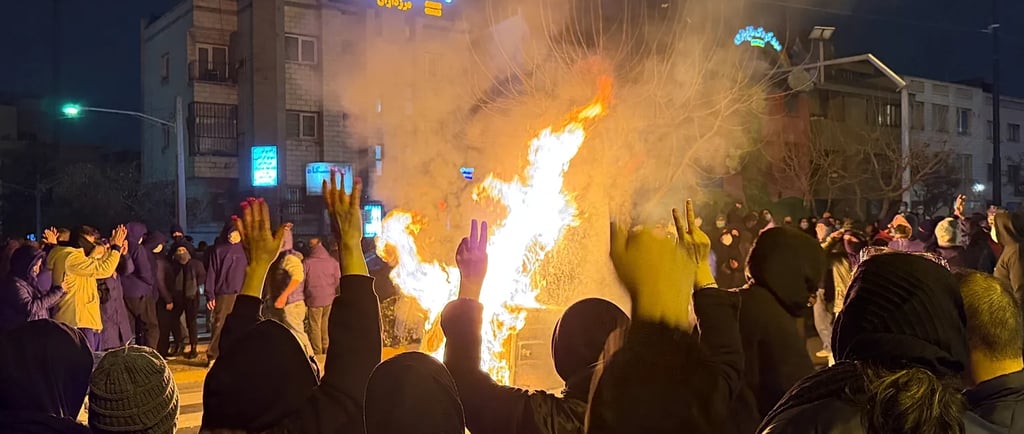
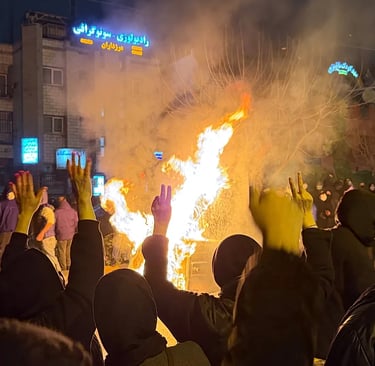
For almost a month since late December last year, mass demonstrations concerning economic hardship and social repression have gripped Iran. A brutal crackdown ensued, with human rights organisations estimating protestor casualties to be well into the thousands. Even as the protests have now largely ceased and the Iranian government has halted prisoner executions, a US carrier strike group has been dispatched towards Iranian waters, and President Donald Trump promised aid to the protestors. With the Iranian government swearing retaliation upon any US military action in Iran, and President Trump also suggesting negotiations, which directions could US and Iranian actions lead global markets and oil prices in?
As more and more protestors took to the streets, and the death toll rose, observers have said Iran is facing the biggest regime challenge since the 1979 revolution that installed the current dictatorship. Many western leaders have said that the regime’s fall is imminent. Recent US actions in Venezuela, along with popular memory of US attempts at regime change in the Middle East, have caused many observers to speculated as to whether the US will attempt to topple the Islamic republic and install a friendlier government. With events’ escalation looking unpredictable, and so many claims of revolution and war being made, it is better to first summarise what will not happen, before summarising what may happen.
While US military action against Iran is certainly possible (as took place last year), and the future equilibrium of domestic Iranian politics is in doubt, investors can be assuaged of two worries: An en masse US-led ground invasion will almost certainly not be launched, now or ever, and the Iranian regime will likely not fall any time soon.
Regarding a US invasion of Iran, it is impossible from a political standpoint, as neither Congress nor the electorate will countenance such a war. While commentators draw comparison to Afghanistan in 2002 and Iraq in 2003, America is not reeling from a massive attack led by militants harboured in Iran. Similarly, the invasion of Iraq was possible in 2003 because the September 11th attacks were still in fresh memory, and no such defensive & retaliatory mindset exists in the current American political climate. It is also unthinkable from military standpoint, as China and Russia are far greater strategic concerns for the US, and the Department of War will not want the bulk of its forces and spending to be tied down far away from either sphere of influence. Additionally, while Iraq is a desert country, prime for the type of rapid maneuver warfare that necessitates only small numbers of troops, Iran is a heavily mountainous one that would require hundreds of thousands of troops to overtake and control. This is also taking into account that Iran is larger in both population and geographical size than Iraq and Afghanistan combined.
While US troops will not be entering Tehran, the regime will also not ‘fall’ any time soon. Many revolutionary events in history have been referenced by commentators as comparisons to what might happen in Iran, and none will take place. Protestors will not storm government buildings and proclaim a new republic. The Iranian armed forces will not stand down and allow Reza Palavi (son of the last Shah/King) to return and assume a governing role. The Islamic Revolutionary Guard Corps (the ideological armed forces) will neither allow nor undertake a coup d’etat against the Supreme Leader or the clerical religious establishment of Iran.
Grassroots revolutions led from the ground-up by a populace against governing institutions only succeed (as shown by history) because elements of constricting governing bodies (police or military) either stand aside or actively aid the revolutionaries, or are too weak to resist. The regime security forces have shown anything but weakness, as they have killed down thousands of protestors and largely quelled the protests themselves. Unlike the Iranian army in 1979, which was not experienced in handling internal unrest, had no strong ideological commitment, and whose officer corps was alienated by corruption and court politics, the IRGC has violently crushed protest movements for decades, has a firm ideological commitment to the Supreme Leader and the Islamic revolution, and has a command structure firmly embedded within the state apparatus. The IRGC is a separate armed forces in Iran; it has its own navy and air force, separate from the regular armed forces. It is explicitly political, unlike the deliberately apolitical regular armed forces. Members of the IRGC sit in cabinet meetings and hold seats in parliament. The IRGC also operates its own financial organisations, firms and businesses. Its commanders have a vested financial interest in the regime’s survival.
While Reza Palavi is seen by many to be the leading (and only) figure of opposition to the regime, he has not been in the country since the revolution in 1979. He does not appear to have any support among any politicians, clerics or military figures in Iran. If he returns to Iran, even in the midst of heightened protests, it is highly unlikely any military units will defect to his cause. Rather, (after a brief civil war) he will likely be captured and executed by the regime. Outside of Palavi, the protest movements do not appear to have any figures or organisations to rally around, unlike in 1979 where the religious cleric Ayatollah Khomeini rallied support and enjoyed significant aid from the religious establishment and dissatisfied elites.
While US airstrikes are certainly a possibility, there is no likelihood of them aiding a collapse of the regime. A thorough air campaign against police, Basij militia (a wing of the IRGC) and IRGC targets by the US would take hundreds of aircraft, while the current carrier group dispatched towards Iranian waters has a maximum compliment of less than one hundred aircraft. Both governments of the Saudi Kingdom and the United Arab Emirates have publicly denied usage of their land or air space for strikes against Iran, constricting the effectiveness of US air power against Iran. Even if the US were to mass air assets in surrounding bases to the point of hundreds of aircraft, and bring more carrier groups to the region, it would still not be enough to break the regime’s ability to control the nation and crush dissent. There are simply too many targets to strike, and those targets that would be struck would be inside civilian centers and would almost certainly see civilian casualties if hit. Regime crackdown would intensify with curfews, internet blackouts and shoot-on-sight orders for security forces. Protesters would also likely cease to gather in large groups for fear of being hit from both the US and security forces. The regime would almost certainly see a boost in support, because it would be able to frame the protests as foreign-backed. If there were any high ranking government or military figures that had sympathy for the protestors’ plight, it would be nullified under mass foreign attack. The enmity of America that so strongly defines the regime’s ideology would become a clear rallying cry, and accidental civilian casualties caused by US airstrikes would only strengthen it. The US could conduct the heaviest airstrike in history, totally decimating the Iranian military, government, and police forces, but unless there is mass scale occupation of the country by a supplanting force, what is left of the security forces there will be able to maintain control. It may be more regionally fractured, but it will still be there and fully able to suppress dissent.
While we have confirmed what will almost certainly not happen, we must now address what may (realistically) happen and how markets and oil prices will be affected.
The worst case scenario at the present moment would be a US air campaign against Iran, heavy enough for Iran to attempt to close the straits of Hormuz (the sea channel between Iran and the UAE and Oman) in retaliation. This scenario would see all shipping in the Persian Gulf threatened, immediate market panic and a sharp increase in oil prices and futures. The ladder of escalation would be unpredictable, as the US may choose to strike Iranian naval assets to counter, which in turn would invite more volatile Iranian actions such as deploying sea mines to threaten even more shipping. The closure could not be carried for too long, as Iran heavily relies on its oil exports for government revenue, but since over 20% of the world’s crude oil supply transits the straits (with oil being carried from such countries as Kuwait, Saudi Arabia and the UAE), the shock would still be felt in international markets. It is worth noting that Iran cannot fully close the straights, as half of its waters are in non-Iranian zones of control, but insurance premiums for shipping in the straights would still likely seize up, and shipping sharply decrease. Iran has threatened to close the straits before, with its parliament voting to do so last year in the wake of Israeli attacks, but has never actually done so. A mass US air campaign against infrastructure, government or security forces (far beyond the limited strikes against nuclear sites last year) would be unprecedented in Iran, and would force the regime’s hand to retaliate to save face (Iranian air defences failed to intercept Israeli and American aircraft in their respective attacks on Iran last year, and any repeated attack would likely see very few losses among US forces). Iran, and perhaps Hezbollah (its proxy in Lebanon), would strike any US air bases that facilitated attacks, but probably not those that stayed inactive. US air bases in Kuwait, Bahrain, Qatar, Iraq and maybe Jordan would be hit, but not bases in Saudi Arabia or the UAE, as both states have denied permission for the US to launch strikes on Iran from the American bases inside them. Civilian centers would likely not be targeted. Houthi actions in the Red Sea would resume, targeting US-aligned shipping, but would not result in a total closure or abandonment of shipping in the sea – disruption and higher insurance premiums would be the target.
If Iranian Supreme Leader, Ayatollah Khamenei, is killed in US airstrikes, the scenario would significantly worsen. It would not result in regime collapse, as the regime has been planning for Khamenei’s death for years, and was prepared to execute them during last year’s war with Israel. An interim leader or council would be declared, and the IRGC would de-facto take the guiding position on policy, domestic and foreign. Protests would be sapped of any legitimacy as Khamenei would be made a martyr, and anyone opposing the regime would be branded an ally of a foreign assassination. The regime would need to decisively retaliate to save face and visibly punish America. Iran and Hezbollah would move to strike US, and possibly Israeli, assets all across the Middle East, regardless of whether they held aircraft involved in attacks or not. Naval actions against the incoming US carrier group would take place, and Hormuz disruption would be far more thorough. Houthi actions in the Red Sea would start again and be infinitely more disruptive, targeting any western-aligned shipping. Oil price spikes would be much larger and last longer, and insurance premiums for shipping around Africa, the Middle East and eastern Mediterranean would balloon. That said, this is quite unlikely. The Trump administration has shown restraint in Venezuela, through capturing – not killing – Maduro, not launching any prolonged air strikes or ground campaign, and not transporting exiled opposition leaders to the country to effect regime change. Similar restraint towards effecting regime change in Iran is likely to be held by the US.
The best case scenario for now would be no US strikes on Iran (and thus no Hormuz closure). Beyond that, US-Iran negotiations and perhaps some deal on Iranian nuclear capabilities, could help markets and oil prices, but not by any substantial level. Some sanction relief will probably come to Iran in the wake of a nuclear deal, but while Iran may enter into negotiations, it may enter to stall for time and prevent airstrikes, rather than out of any genuine wish for an agreement.
While ‘nothing happening’ may be the best foreseeable outcome for markets and oil prices, there is another scenario, much better for oil prices and markets that, although unlikely, is still likelier than a US invasion and the regime being toppled; regime liberalisation. This is much more long term in scope, but it is the best possible outcome for investors, markets, oil prices and U.S. geopolitics. For comparison, we may look to the USSR after Stalin or China after Mao – A peaceful change in political elites and reorganisation of governing power that gradually lessens repression, allows for more political and economic freedom for its citizens, and adopts a less hardline approach to the west. The most optimistic outlook would see significant sanction relief and subsequent market reforms (akin to, although probably not as far-reaching as, post-1990s China), allowing for foreign investment in Iran. Regime liberalisation in Iran would still see quite an authoritarian system (perhaps still a dictatorship), but one in which upward financial mobility is possible, a middle class can grow, and the country is not dependant on Russia and China for finance. Iran is allied to Russia and China out of tactical convenience – their shared enmity of the US – which heavy sanctions aid. They make Iran more economically reliant of China buying oil and Russia buying weapons. Regime liberalisation would not make Iran a US ally, but it would draw it way from being a close Russian and Chinese ally.
How could this happen? Regime elites have a clear motivation for it. The protests were unlike anything Iran has seen, and far surpasses 1979 in civilian participation and death toll. They were nationwide, youth-driven and sustained for weeks – The civilian resentment towards the regime will not dissipate through force alone. Unlike China after the Tiananmen Square protests, the regime cannot easily enact market reforms (due to sanctions) to bribe its populace with increased living standards. While it may have survived this round of protests, there is no guarantee that it will survive future round of protests, especially if sanctions tighten and economic plight worsens. Regime elites know this, and do not want Iran to become a permanent bunker state holding its population at gunpoint, reliant solely on China and Russia to stave off total economic collapse. The Supreme Leader, together with IRGC commanders and some government technocrats would sideline the clerical establishment (Iran is a theocracy, in which its religious authorities hold much of the domestic political power), relax some social controls (such as dress code for women) and strip the morality (religious) police of their right to make arrests (similar to what was done years ago in Saudi Arabia with their own religious police). Social reform, along with a new nuclear deal, would certainly see a sharp reduction in sanctions, and possibly the reintroduction of western investment into Iran.
As said, while protests may have been repressed and US aid seems impotent, the regime cannot simply determine the population cowed and continue governing as normal. Just because there are no military units or elite figures ready to aid an uprising now, does not mean there will be none forever – especially for future nationwide high-casualty protests. If US negotiations are not pursued, sanctions not lifted, and no form of social reform or liberalisation pursued, the possibility of the regime falling through a coup or revolution is significantly higher. Authoritarian regimes must always rely on at least a semblance of popular input – the ability of ordinary people to make the government listen to them and give into some demands – but all pretence of government-civilian co-operation in Iran has been lost as a result of the recent crackdown. The Islamic Republic is ruling by pure force alone because, aside from halting the execution of prisoners, it has done – and is currently doing – nothing to placate the concerns of its citizens, whether they be about the economy or governmental overreach. The Islamic Republic may not fall to a domestic revolution or foreign invasion any time soon, but if it refuses any kind of compromise or reform, its days will undoubtedly be numbered.