Gold: The Intersection of Tech, Tariffs, and Timeless Value
In today’s volatile global economy, which has been shaken by tariffs, technological shifts, and speculative bubbles, gold’s surge in value has taken on new and unexpected dimensions. Will gold’s shine endure, or will its brilliance fade under the weight of changing times?
GLOBAL
Daniil Sklyar
12/13/20257 min read
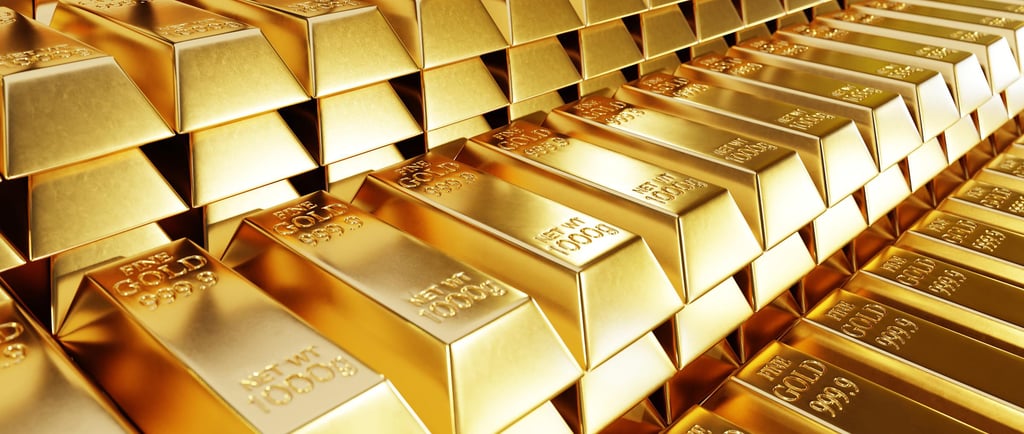
Gold has been a safe haven asset, or in other words, a reliable store of value in turbulent times, for at least a century. Along with other safe haven assets, namely the United States’ treasury bills; some currencies, such as US dollars and Swiss Francs; and defensive stocks, gold has been one of the primary tools for hedging portfolios of investors during times of economic instability of any kind. Tariffs, enacted by US President Donald Trump, caused exactly this. Tariffs sent markets into a downward spiral for multiple days in a row. It was reflected in market health indicators such as S&P500, NASDAQ, and Dow Jones, losing their positions and thus driving participants of these markets to act out of fear and uncertainty. In this scenario it is only natural to assume that stakeholders would opt to convert some of their assets into safe haven investments. However, the question stands: why, out of all the aforementioned safe havens, did gold experience such a drastic increase in value? Moreover, how fair would it be to assign the rapid growth of the price of gold to tariffs, considering that gold’s price has been beating its all time records for four years straight? While the answer to these questions can essentially be boiled down to persistent economic instability, increased demand for gold and as a result, its increased price, the ultimate all time high that gold reached after the tariffs have been announced, cannot be explained as simply. Combined with general market pressures, tariffs made other safe haven commodities less viable while simultaneously increasing the demand for gold across multiple industries during critical time for said industries.
Before addressing the concern that the rise of the price per ounce is not unique to the tariff announcement, it is important to delve into some of the mechanics of gold as a safe haven asset and what makes it such. The general mechanism behind it is quite simple. Gold is a historically renowned store of value, it has been used as such in almost all parts of the world and in almost all banking systems for almost as long as money as a concept has been in place. On top of that, gold is tangible, it can be physically owned and stored. As basic as it is, this trivial fact adds some superficial, but nonetheless important confidence to gold’s owners, especially when the markets are remarkably volatile or the political or social situation is especially unstable. Just these two factors make gold an attractive commodity to an average investor. But what makes gold one of the few true safe havens is that its price does not rely on arbitrary metrics such as performance of business or performance of the government. It exists outside of this system and only relies, in simplest of terms, on supply and demand. There is a limited amount of gold that has ever been mined and this amount is very unlikely to ever drastically increase. Annual inflation created by gold mining is essentially negligible compared to currency inflation, especially considering that increasingly stringent regulations are being applied towards gold mining as part of nature conservation efforts. Considering its inherently limited nature and common consensus that gold is a store of value, it is clear why, when demand for gold increases, so does its price.
Now, before understanding specific circumstances that led to an all time record spike, it is important to address circumstances and crises that preceded this spike. Indeed, it is clear that as a phenomenon, upward pressure on gold prices during market instability is essentially universal and can be traced along with almost every single economic crisis of this century: 2008’s Great Recession, 2020’s pandemic, 2022’s military conflict between Russia and Ukraine have all been followed by gold’s price increasing. What is important to note is that the period between the last few major crises of 2020 and 2022 is relatively small, compared to the period between 2008 and 2020. The majority of the investors only use gold as a hedge in times of uncertainty and almost never use it as their primary investment vehicle if the markets are stable. In a healthy economy, in the long run, gold tends to underperform. For example, S&P500’s annual returns for the past 15 years average out to 17.5%, whereas returns of gold (not including the latest record spike) average out to approximately 6.5%. Despite that, there is a clear trend: the price of gold has been increasing since 2020 and so far it has not fallen past its pre 2020 value. It serves as a clear indicator that despite periods of relative stability, investors chose to hedge their assets more and more using safe havens. Thus emerges the first underlying factor that influenced such a drastic increase in gold’s value: persistent general uncertainty lasting for a long period of time.
However, the general trend does not fully explain the phenomenon that occurred thus it is important to address specific conditions that tariffs have caused. Ultimately, it means answering the question why gold and not other safe havens? In short, gold not only retained its status of a reliable and turbulence proof asset, but also offered high return on investment, unlike most other safe havens. The fundamental issue with tariffs is that they undermined confidence in international trade. A concern similar to the one raised during lockdown of 2020, but additionally exacerbated by consecutive years of market instability. This concern made foreign cash a rather flimsy hedge, as predicting the behaviour of the currency price was rather challenging at the time. Especially considering that US tariffs didn’t exclude even some of the closest allies, making even Swiss Frank not as solid of an investment as gold. On top of that many experts predicted that tariffs would cause accelerated inflation, which makes the US dollar a less attractive investment, especially for the local US market participants. Defensive stocks, popular during times of longer recessions, were much less attractive to investors due to the concerns that the tariffs could merely be an instrument of political pressure to achieve short term goals and that the trade war would not last long. By investing heavily into defensive stocks, investors would have willingly sacrificed potential profits they could have reaped from increased demand for gold. The same applies to the US treasury bonds. While being exceptionally secure, bonds offer profits that are negligible, compared to those of gold. Considering all the factors above it is evident that gold was not only attractive due to its safety as an asset, but also due to its ability to substantially increase value in times of crises, rendering all other safe havens less attractive.
Aside from specific conditions that tariffs created for all safe haven assets other than gold, it is important to mention the role of the rapidly growing AI industry. AI affected gold’s price in two distinct ways. Firstly by increasing the demand for gold in the market where the demand was already high and secondly by inciting fears of the entire industry being a bubble. Elaborating on the first point, AI increased the demand for gold through chip production. One of the industries that has dramatically increased its use of gold in the last five years is chip manufacturing. Rising demand from the AI industry that needs sophisticated chips to satisfy their gargantuan data center construction goals drove manufacturing giants such as NVidia to produce record numbers of electronic chips. Each of these chips uses a comparatively miniscule amount of gold. However, at the scale that these chips are being made, it decreases the amount of readily available gold. Considering the aforementioned idea that the less gold there is in circulation the higher the price, the AI industry and chip production contributed to the creation of the gold market that we see today. Combined with the fact that chips can be used for years on end and not recycled for decades, some of the gold used in them might be taken away from the market for a very long time. As for the second point, extremely quick growth of the relatively new AI industry instilled a fear into both consumers and investors that AI is a bubble, comparable to that of a dot com bubble that burst in 2000’s. A monstrous market capitalization of just a single AI related company NVidia (4.47 trillion dollars) is bigger than market capitalization of most big pharma companies combined (approximately 4.2 trillion), and yet profits of AI companies do not seem to match (in some cases, like the market leader Open AI, profits are actually in the negatives). These factors pull investors closer to gold, especially considering the lack of more attractive options that was discussed previously.
The last factor that contributed to the gold’s price increase was the crypto crash that happened on the 10th of October this year, making alternative investment strategies less attractive. For as long as crypto currencies existed they were considered an attractive alternative investment. Even though crypto currencies are volatile and cannot be called safe havens, some of their properties are comparable to gold. Namely, the fact that crypto currencies, similarly to gold, do not rely on arbitrary metrics such as business performance. On October 6th, bitcoin reached an all time high, as it was one of the most popular hedges during the period of market volatility and resembled behaviours similar to that of gold. However on October 10th, when Trump announced a 100% tariff on China’s imports that included tariffs on rare earth metals used in production of chips used to mine and manage bitcoin, the crypto market crashed. In fact, the crypto market is still yet to rebound. This incident has shown to investors that tariffs created a unique situation where even the alternative investment strategies that were generally considered safe, are not guaranteed to even retain the value of investment, let alone increase it, thus further boosting demand for the last available safe investment (gold).
Considering all those factors, it is evident that tariffs have created a unique situation during a unique time. The combination of a new, emerging industry that is dependent on gold and that has trillions of dollars circulating through it, and extreme market uncertainty caused by unforeseen trade hostility, made it possible for gold to hit an all time high. On the 17th of October, it reached 4379 dollars per ounce. In other words, extremely rare market conditions brought an extremely unlikely scenario to life.